ux was here
A re-envisioning of a social-media platform created for the UX designer community
00
problem
After launching UXwasHere, a platform used to connect UX designers worldwide, founder Matt Karakilic ran into two major problems. Firstly, he didn't have a defined audience making it challenging to understand users needs and motivations. Secondly, he found that user retention on the site was low, keeping users from exploring and experiencing the site at its fullest potential
solution
We reimagined UXwasHere to be a community platform for design advocates (rather than a solely career-finding network). By reorganizing its structure to prioritize peer-to-peer interaction, the platform allows deeply passionate designers to learn, connect, and grow amongst each other. We also priortized a space for user-created design challenges as a way to ensure users would continually return to the website.
UXwasHere, created by Matt Karakilic, is a social media platform that aims to unite UX designers around the world. For the 2024 Eunoia UX Design Jam, our team's goal was to determine how to bridge the gap between prospective users and this new platform.
With such a short and intense design jam, my teammates (Elsa Sinuhaji, Erika Hance, and Linda Jolly) and I made sure to get started on our solution to Karakilic’s problem immediately. As the lead researcher, I scoured the provided documents from UXwasHere and found that, shockingly, only 3.54% of users made it beyond the site's landing page. Very few people checked out features like events, job listings, or feedback. What was going wrong? What needed to be done in order to convert visitors to users?
To pinpoint the issue, we completed some user testing within our group, finding that there were two main reasons why users were abandoning the platform shortly after discovering it. The first glaring issue was the site's lack of usability; many features were either hard to use or flat-out broken. Nobody wanted to use a social media platform that wasn’t as intuitive as the other platforms that have already been out for a decade or more. Secondly, we all felt that UXwasHere was trying too hard to reach any and every user with its offerings, which, in turn, made it unclear who the platform was for. With influences from LinkedIn, ADPList, and Design Buddies, it was trying to be the best of them all, while its website was leaving more to be desired. Our team left with the driving question, “How might we empower UX advocates in Vancouver to nurture community, meaningful connections, collaboration, and long-term growth to amplify their personal and professional impact?”
It was clear that we needed to start from scratch on how to make Karakilic’s idea come to life. This wouldn’t just be a case of a simple rebrand, but it would be an overall refocusing to determine what the UX community needed for the future. Our first goal was to narrow down the demographic and then rebuild the platform to suit their needs.
As we only had three days, we had to start creating as quickly as possible. While Erika and Linda started to create the UI/visual language for the new-and-improved UXwasHere, Elsa and I worked on creating the ideal user flow, minimum viable product (the most important features that users would need), and the overall layout of the platform. After a lot of discussion, we boiled UXwasHere down to the utter essentials, including:
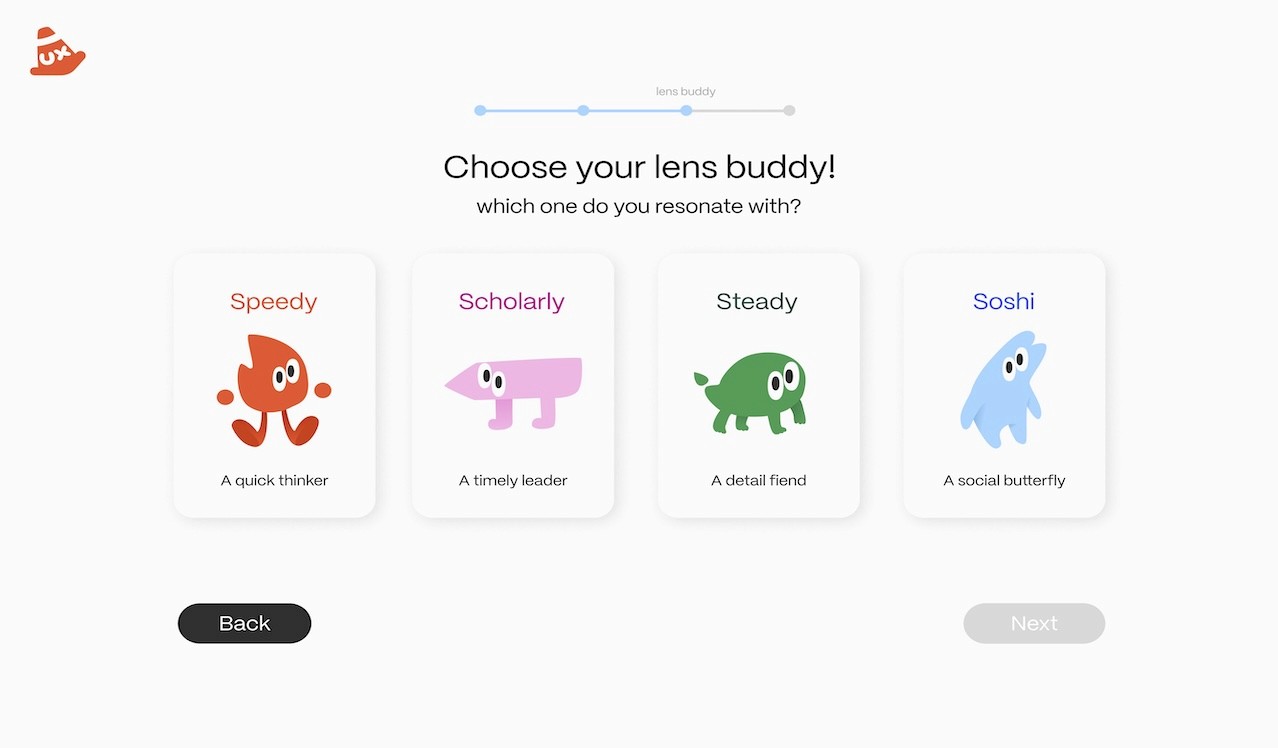
Onboarding: A way for users to get introduced to the platform while also making the experience more personalized. Users are asked questions about their general interests and also get to choose a “lens buddy” - an attribute that best describes how they approach the UX design process.
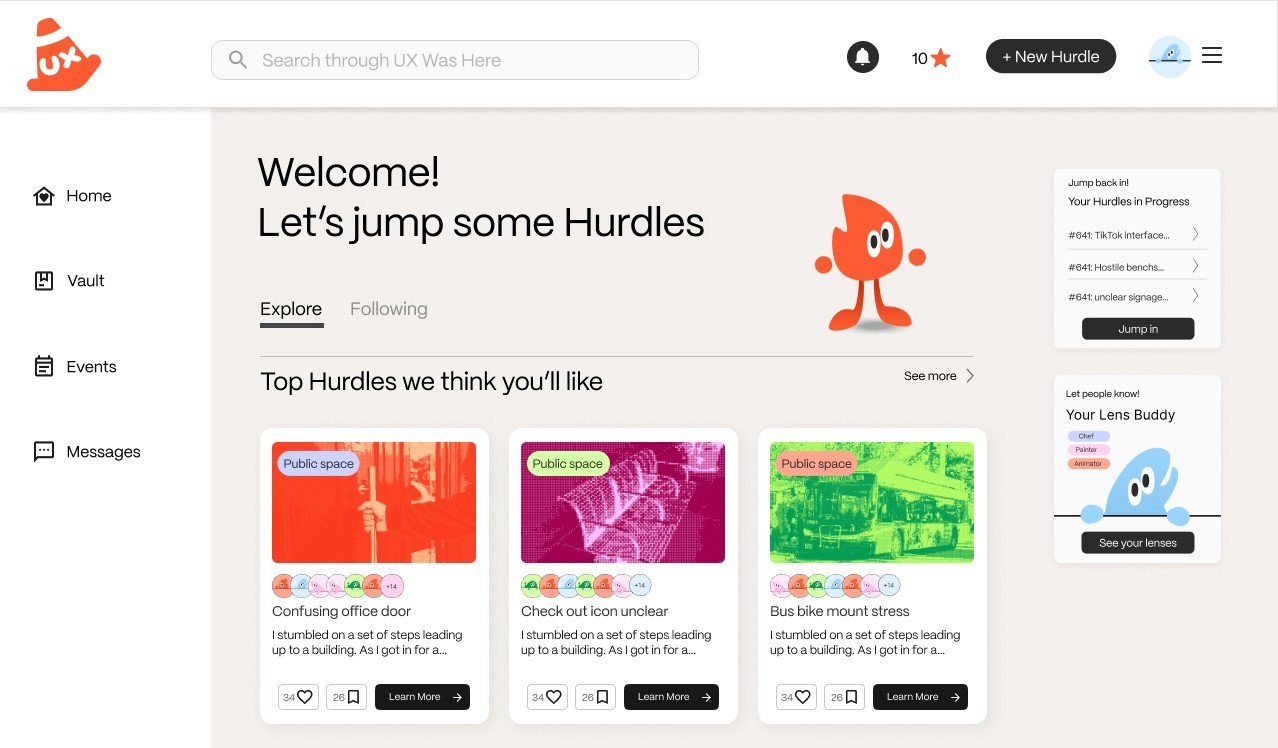
Home Page: A common area where users' hurdles are shared for everyone to drop in and give their advice on. It also features suggested people to follow, trending hurdles, and hurdles catered to you!
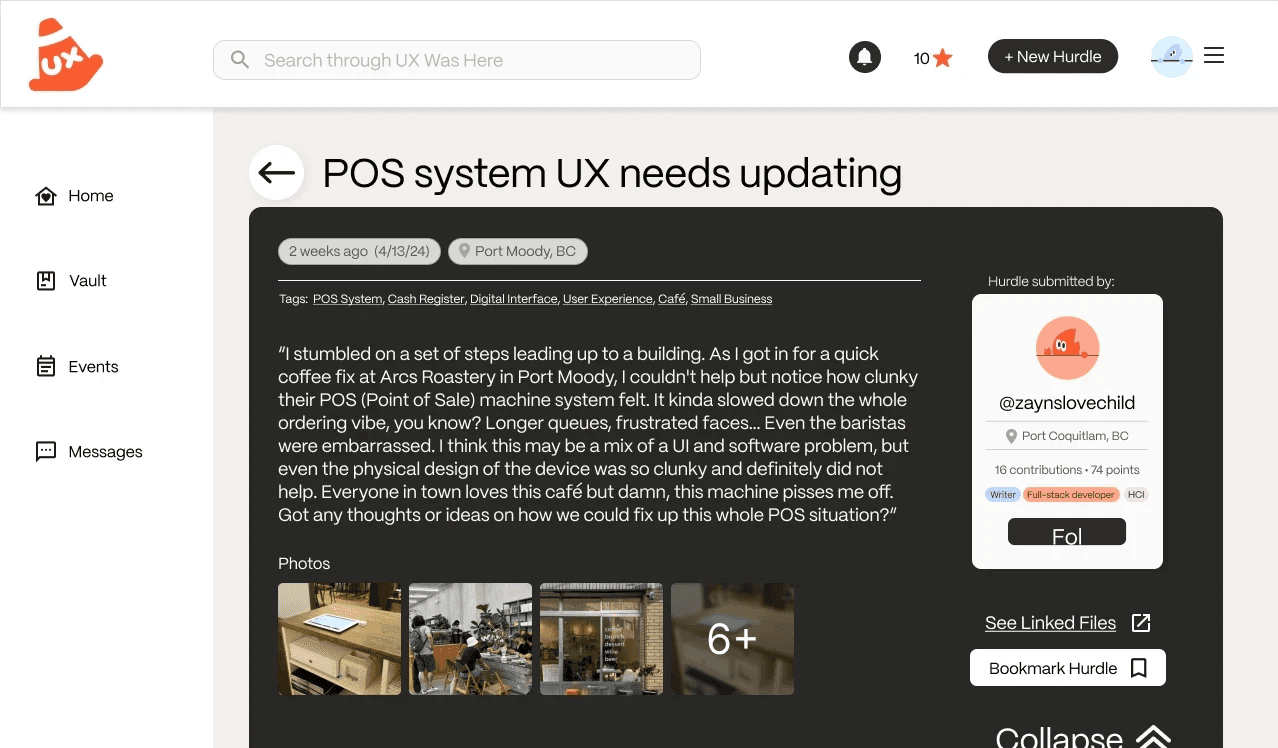
Hurdles: These are user-created UX problems that the community can help with. Users provide information about their hurdle, alongside photos and the specific problem space they are working in (UX, User Research, etc.), and the community can post their responses as a way to offer a different perspective.
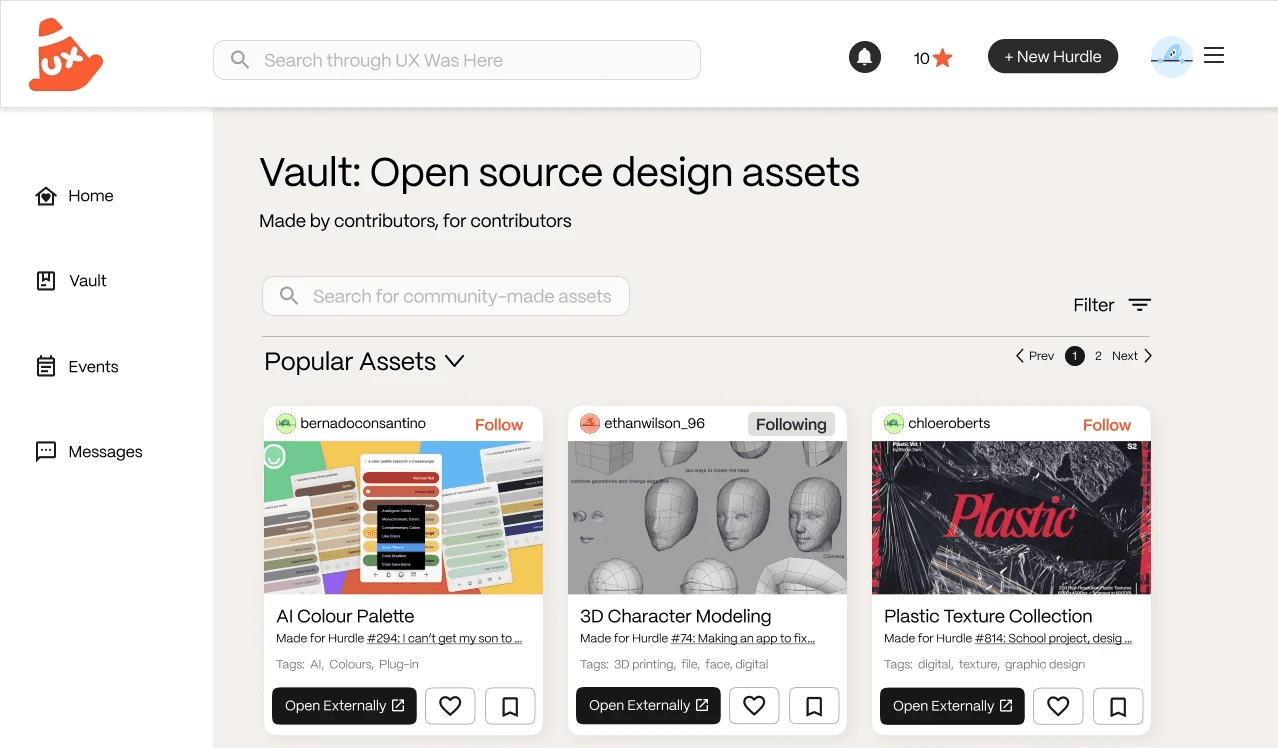
The Vault: A space for open-source community resources and assets for the UX design community. These can be anything, from a link to a YouTube video or Photoshop Mockup assets.
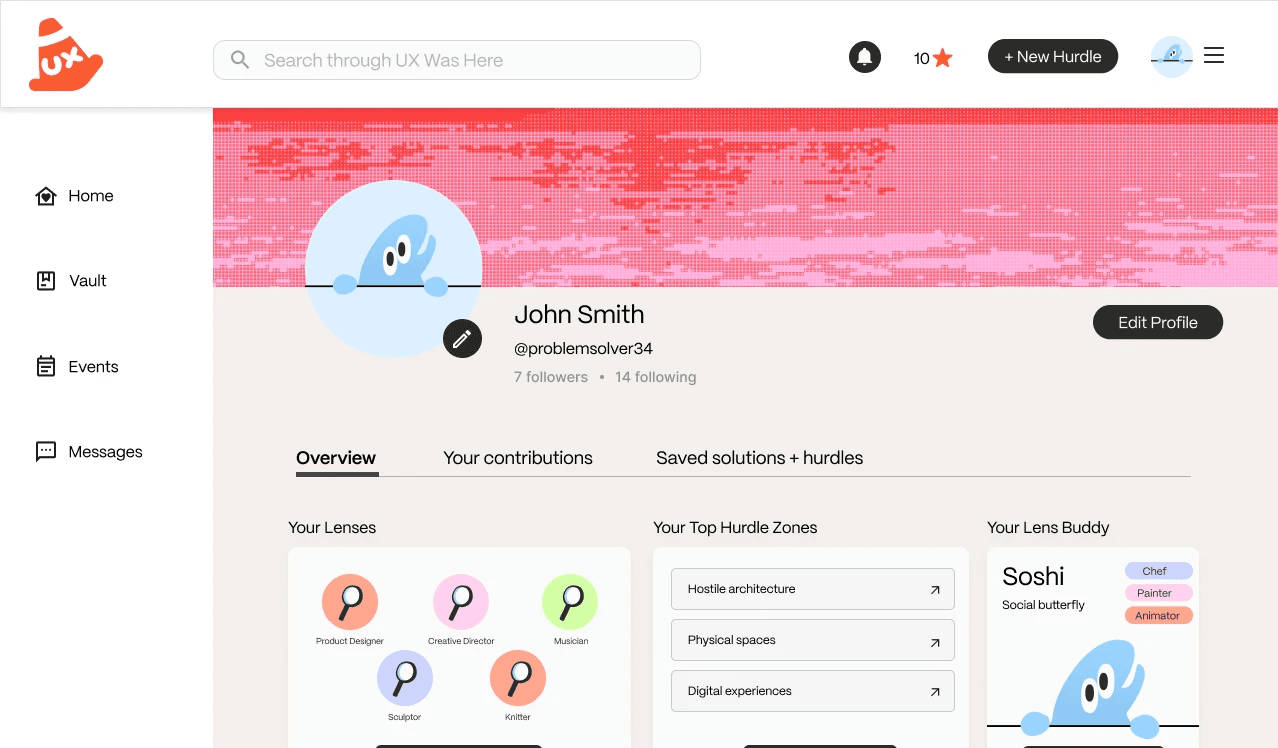
Profile: With any social media, a profile page allows the community to get to know you better. Here, the user can showcase their contributions to hurdles, what problem spaces they usually work in, and the statistics of how they’ve helped out others on the platform.
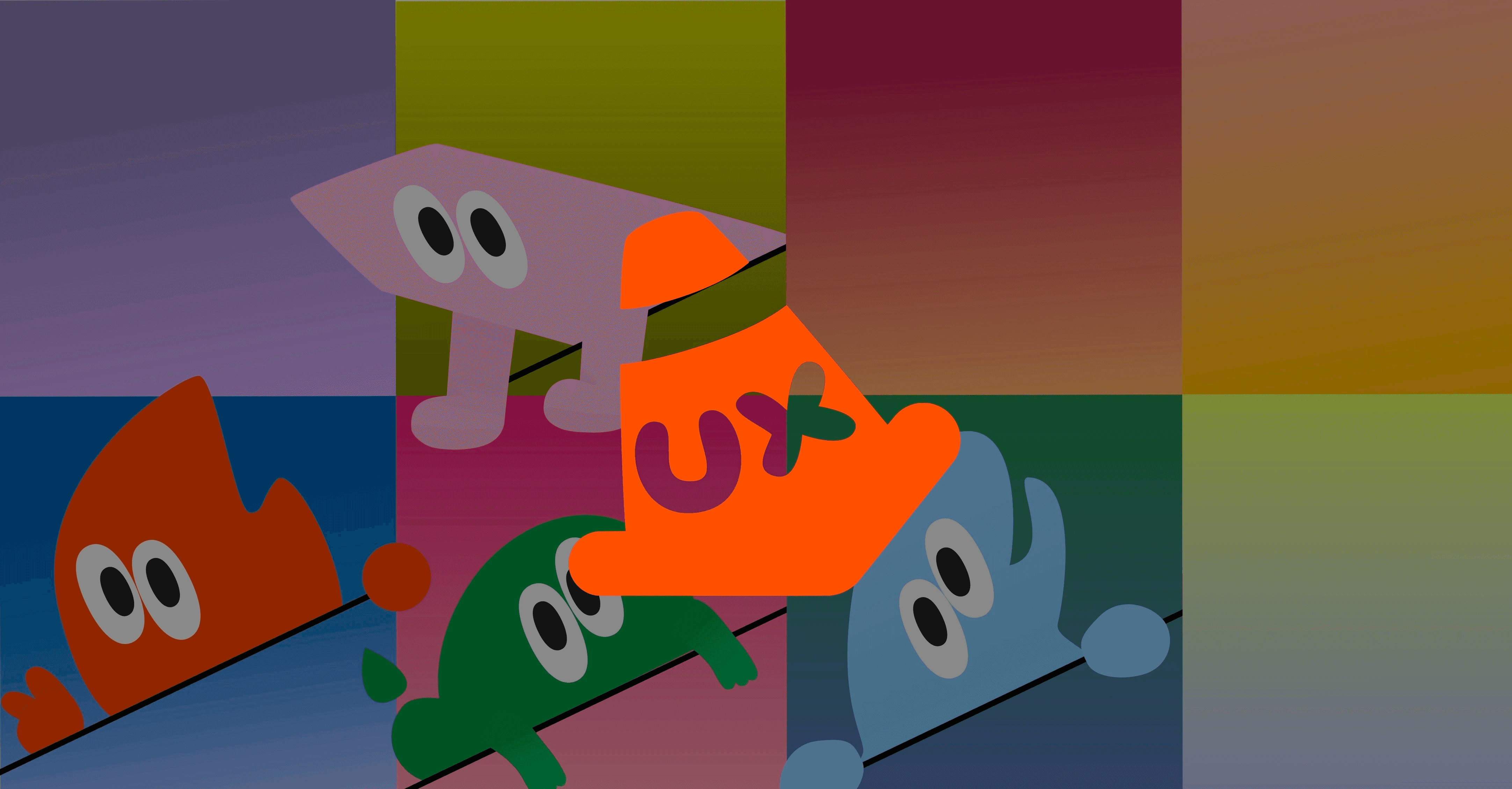
With the implementation of Erika and Linda’s UI, the platform fully sprang to life. Although it wasn’t my contribution, I loved the addition of the illustrated “lens buddies” to the platform. That, alongside the modern and colorful color palette, just helped reinforce the idea that this was a community for young UX designers and design advocates to collaborate and grow together.
Overall, I believe that the design proposal reinforces the original product vision of creating an engaging community of passionate design-thinkers. This new site empowers people to see problems as opportunities for change, creating a positive impact within their community. If this proposal were accepted, I feel that the platform would create sustainable growth over time and earn high levels of user loyalty.
Personally, I think our team did a great job at rising to the occasion in such a short time frame and going above and beyond to find a unique solution. My research and user testing made us push ourselves to the limits with what we could accomplish, and I believe that our final product was an amazing accomplishment. After reading the judge's feedback (click here to read), I understand that we did stray a little too far from Karakilic’s intended vision - with the lack of a client-designer relationship due to the nature of this case study being a competition, we were unable to get feedback on any of our decisions.
see also